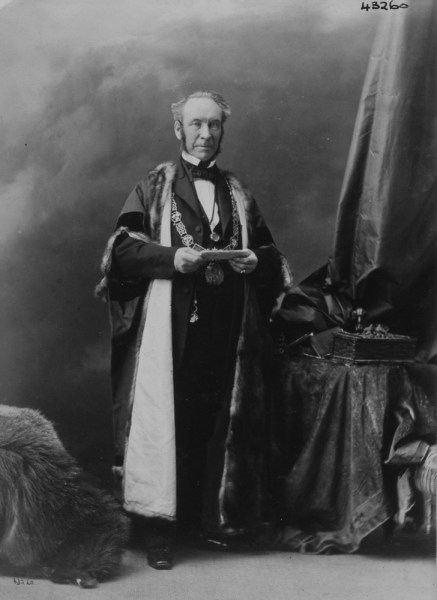
The Master Shipwright: The Life and Death of John O’Bray Senior

Thursday, December 11, 1845, a biting easterly wind that had held Pembrokeshire, Wales, in an arctic grip for days as John O’Bray Senior, my third Great Grandfather, stepped out of his home at 14, Queen Street, East, bundled up against sub-zero temperatures, and the aftermath of a major snowstorm.

14, Queen Street, East Pennar, Wales, circa 2021

A thick layer of dry, powdery snow covered the ground—a rare sight for Wales that would linger for over a week due to the sustained freeze. (1)

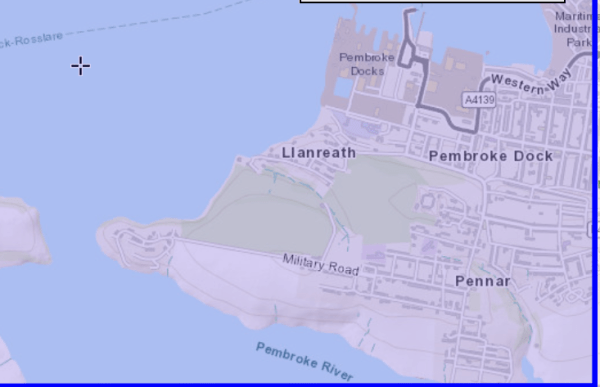
John was an “old servant” of the Pembroke Royal Dockyard (the Paterchurch site). At 53, he was a master shipwright who had walked these paths since he was a twelve-year-old boy. He lived in Pennar, a district on a headland perfectly situated for dockyard workers. Pennar was one of the first residential areas to expand alongside the dockyard’s rapid 19th-century development.

Map of Pennar and Pembroke Docks

A Lifetime of Service

Records from Richard Rose’s “Pembroke People” provide a clear timeline of John’s long career:

  • June 24, 1805: John entered as a shipwright boy at Milford, aged 13. He was paid 2 shillings a day.
  • July 1812: He became a full shipwright at age 21, earning 3 shillings and 4 pence a day.
  • April 20, 1812: Just before his promotion, he married Eleanor (Elinor) Allen. Together, they raised ten children.
  • A Lineage of Craft: John was part of a multi-generational dynasty. This trade—from shipwrights to boilermakers—continued for over 150 years, ending with my grandfather, Percival Victor O’Bray. They were the “naval backbone” of Britain from the Napoleonic era through the World Wars.

The Fatal Morning

On that freezing morning, 1845, John was working on the ‘slips’—the massive, sloping masonry platforms used to build and launch ships. At Pembroke, these were not open to the elements but were covered by enormous, echoing iron and timber roofs. Despite the roof, the dry powdery snow would have drifted through the open ends of the slips, and the east wind would have whistled through the scaffolding, coating the wooden planks in a treacherous glaze of frost.

For a significant vessel, the slip might rise 6-12 meters (20-40 feet) or more from the low water mark to the top of the slip’s working area, with the slope extending a considerable distance into the harbour (2)

The Accident

As John crossed a stage surrounding a ship’s hull, a common but deadly scaffolding error occurred. A plank had been “short planked”—it did not have a sufficient overlap on its support. As John stepped past the pivot point, the plank acted like a seesaw, tilting upward and sending him plummeting to the stone floor below.

The Carmarthen Journal (December 19, 1845) reported the tragedy:

An efficient and industrious shipwright, named John Obrey, (sic) belonging to Her Majesty’s Dock Yard at Pembroke, fell from a considerable height into one of the building slips, and was killed on Thursday last.

To mark the esteem in which he was held by the authorities of that establishment, the Chapel bell of the Arsenal was tolled during the funeral. * It appears a plank forming one of the stages aroundthe ship’s side had not sufficient hold of the support on which it rested, and the weight tilting it up, he was precipitated into the slip, and falling on his head.***

His skull was so fractured that his brain actually protruded. His wife will, no doubt, have a pension, though the amount must necessarily be small”

* The Chapel Bell of the Arsenal tolling is a significant detail. It shows that John was not just a nameless labourer; he was a respected member of a tight-knit community. The “Arsenal” refers to the fortified nature of the Pembroke Dockyard, which was protected by a series of Martello towers and barracks to defend the valuable ships under construction. (3)

** The Pension The Carmarthen Journal’s mention of a pension for his wife, Elinor, is noteworthy. While “small,” the fact that a pension was even discussed suggests John’s “old servant” status (his 40+ years of service since 1803) granted his family a level of consideration not always afforded to Victorian labourers.

*** The Hazard of Short Planking. The description of the plank not having “sufficient hold of the support” suggests a common but deadly scaffolding error. In the rush of a busy dockyard, a plank that didn’t overlap its support sufficiently could become a “seesaw” the moment a worker stepped past the pivot point.

Also reporting was The Pembrokeshire Herald and General Advertiser, 19th December, 1845, Page 3

A fatal accident befell one of the workmen in Pembroke Royal Dockyard last Thursday. On crossing a stage, he stepped on a plank which gave way under him, and falling into the slip upon his head, was killed on the spot. His brains were actually seen oozing through the skull. His name was O’Bray – an old servant and an active mechanic”

Those phrases, ‘brains actually protruded’, are graphic, but show the brutality of industrial work in the 19th century. The contrast between the “industrious shipwright” described in the newspapers and the brutal nature of his accident highlights the high stakes of Victorian maritime labour.

Faith and Final Rest

At the time of his death, John served as a clerk for his local church. Interestingly, he had converted to the Church of Jesus Christ of Latter-day Saints, though he passed away before he could be formally baptised.

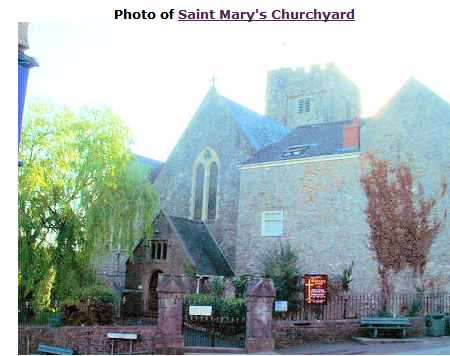
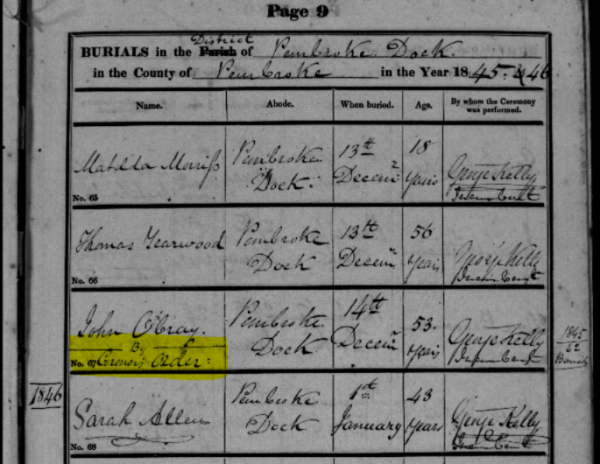
His wife’s family had roots in early Methodism in Milford and Pater, showing a family history of deep religious conviction. John O’Bray, Senior, was buried by Coroner’s Order at Saint Mary’s Churchyard in Pembroke.

John was buried by a coroner’s order

Sources

These historical weather records below detail the cold temperatures and snow cover experienced in Milford Haven during December 1845

  1. Central England Temperature (CET) records and regional logs for the winter of 1845–46. Met Office Historical Weather Records / “The Climate of Pembrokeshire.”
  1. https://www.ice.org.uk/what-is-civil-engineering/infrastructure-projects/pembroke-dockyard#:~:text=Did%20you%20know%20%E2%80%A6%20*%20Pembroke%20Dockyard,first%20iron%20roofs%20to%20shipbuilding%20slips%20(1845).
  2. https://en.wikipedia.org/wiki/Royal_Navy_Dockyard

Notes:

Recorded here at https://www.cnrs-scrn.org/northern_mariner/vol03/tnm_3_1_1-43.pdf, is a historical fatality, which could be a mention of John O’Bray’s death:

Documentary evidence from the era records instances where planks forming these stages gave way, precipitating shipwrights into the slip. One such record describes a worker falling headfirst from a stage, resulting in a fatal skull fracture upon hitting the stone floor”

Uncle Paul to All

(Updated – “Be Kind” is my new motto and Uncle Paul was one of the kindest people ever!)

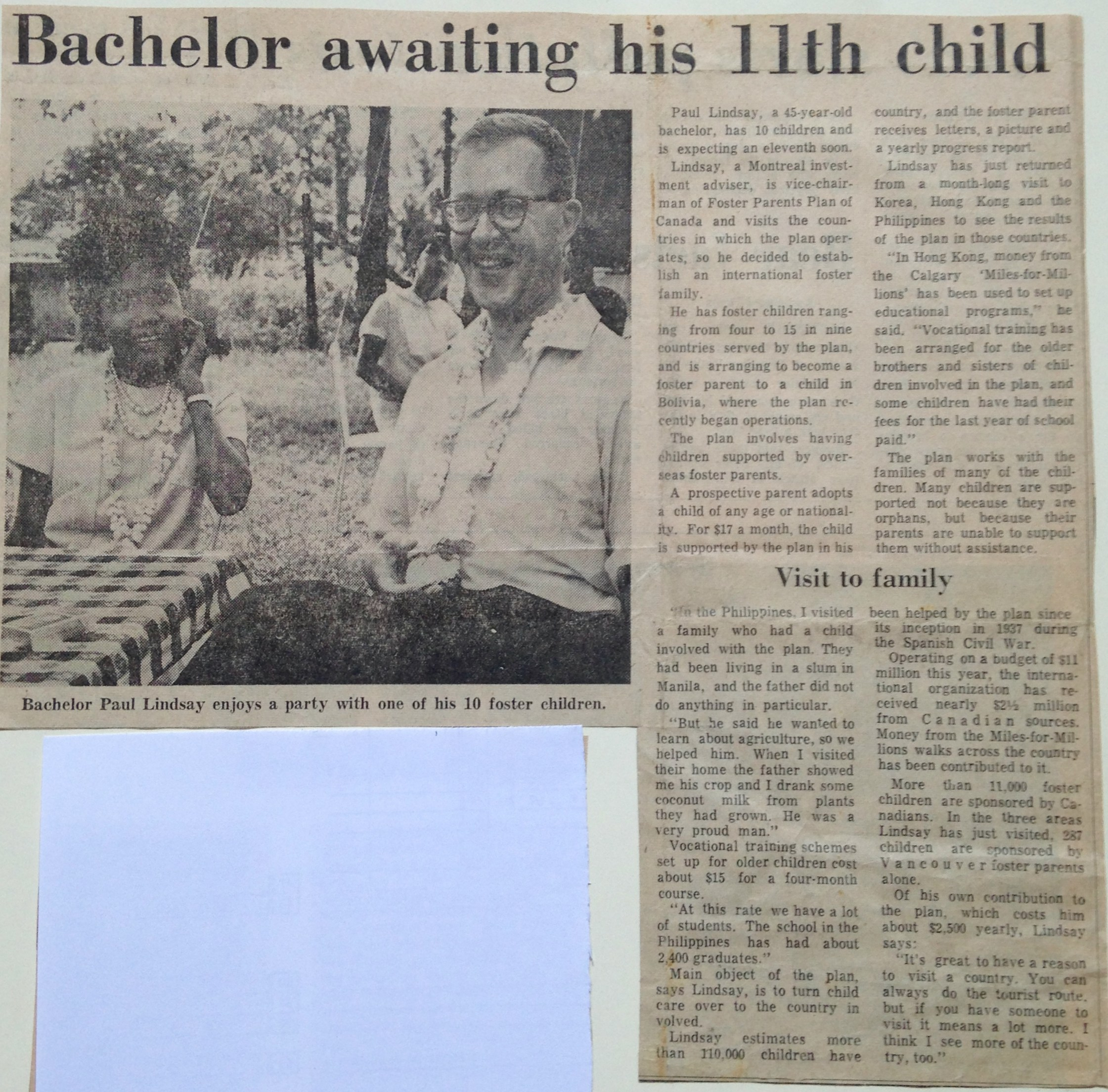
The headline read: “Bachelor awaiting his 11th child”. The 1969 newspaper article covered my Uncle Paul’s month-long trip to Korea, Hong Kong and the Philippines to visit “all his children”[1]. He sponsored his first foster child in 1961 and, eight years later, he had 11 foster children.IMG_30281969 – Uncle Paul travels internationally to visit his foster children.
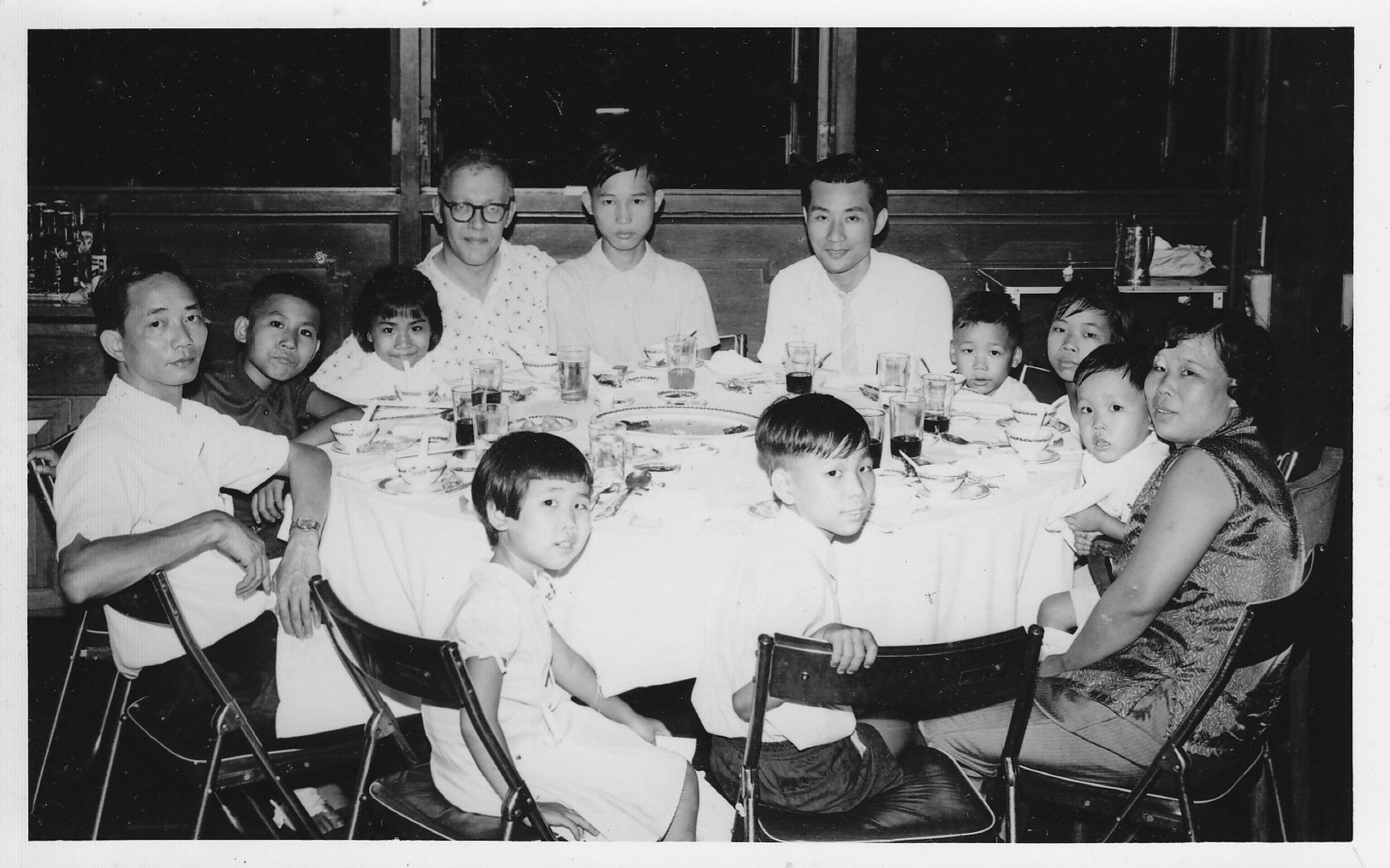
My uncle, Paul Lindsay (1923-1987), was my mother’s only brother. He was interested in how the money raised by the Foster Parents Plan[2] was spent helping children and their families in developing countries. So, in 1969, he booked the first of several trips at his own expense and visited all his foster children in person. He was greeted like a hero everywhere – sometimes with a banner across the main street reading “Welcome Uncle Paul”.Foster Kids 1969Uncle Paul with some of his foster children and their family.


He served for 20 years as a director of both the Canadian and international organizations of Foster Parents Plan (now known as Plan International).  His ultimate dream was to have two children, a boy and a girl, in each of the areas served by the organization.

Uncle Paul worked as a stockbroker with the Montreal brokerage firm MacDougall, MacDougall, MacTier.  Every weekday afternoon, he left work early and volunteered two hours of his time at The Montreal Children’s Hospital, playing with the kids in the orthopaedic ward. He was much appreciated and recognized as one of their principal volunteers during that time. Years later, I wrote and dedicated a children’s book to him called Bonnie – The Car with a Heart.[3] All proceeds from the sale of the book were donated to the Montreal Children’s Hospital in his memory. But not even “Bonnie” had a heart as big as Uncle Paul!

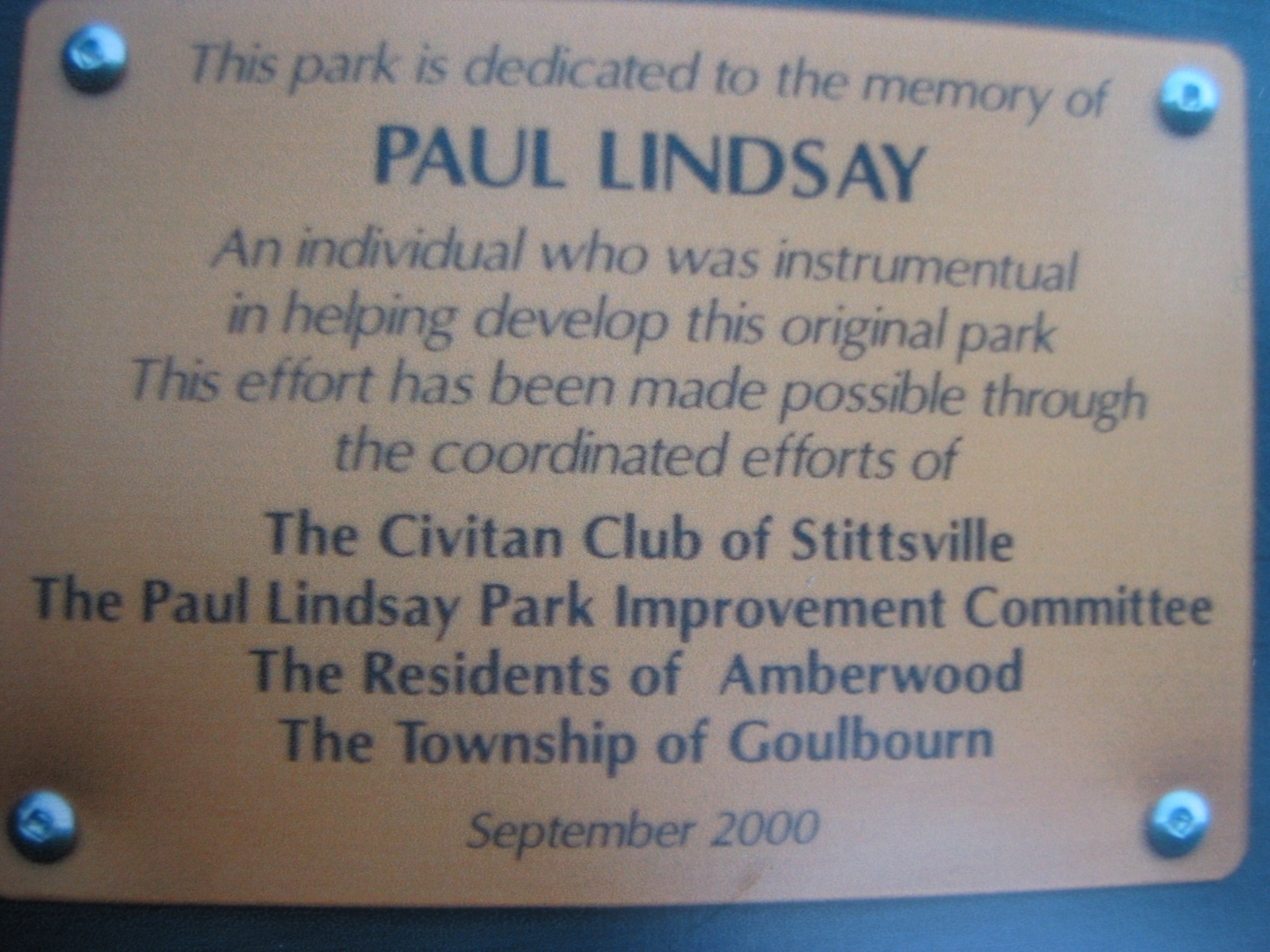
After his retirement in 1983, he moved from Montreal to Amberwood, a small community in Stittsville  just west of Ottawa. He quickly became a well-known member of his new community. One of his proudest moments was being approved as a “block parent” with their official sign posted in his window. In the year 2000, shortly after his death, the local park he helped develop for the neighborhood children was named after him.Paul Lindsay memorialPaul Lindsay Park DedicationIMG_0839Uncle Paul’s Nieces, Nephews and Family – May 2018
Another of his passions in life was music, listening to his high-end audio system as well as singing with the Montreal Elgar Choir for 30 Years[4]. When I was very little, he would cup my ear and say my pet name, “Little Lou”, in his deep baritone voice. The vibration tickled and made me shiver with delight.

Uncle Paul loved games! Perhaps it was the child in him. All kinds of games: golf, bowling, cards, Scrabble … and betting games at racetracks and casinos! He had a holiday apartment in the French Riviera (possibly purchased with his casino winnings? Who knows!) When in town, the French children would gather at the local café waiting for “Oncle Paul,” eager for the promised coin or two. I stayed there with him one night in 1974 while backpacking around Europe with a friend. The next day, he bid us “au revoir” both of us with our own bottle of French perfume as a gift.

My cousins and siblings all have fond memories of our Uncle Paul.  We never minded sharing him though; after all, he was Uncle Paul to all!Paul Sydenham Hanington Lindsay (1923-1987)
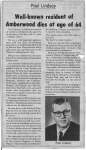
[1] The Province, Vancouver, BC – August 12, 1969

[2] https://wiki2.org/en/Plan_Canada – as referenced August 12, 2018

[3] Bonnie – The Car with a Heart, written and published by Lucy H. Anglin – September 2010

[4] https://www.thecanadianencyclopedia.ca/en/article/montreal-elgar-choirchorale-elgar-de-montreal-emc/ – as referenced August 12, 2018

William Workman: Public Successes, Personal Problems

The Workman family plot in Montreal’s Mount Royal Cemetery is a large one, including six large tombstones engraved with the names of almost 30 people. But William Workman (1807-1878), a successful businessman who served as mayor of Montreal for three years, is not buried there. He was laid to rest alone, in a large mausoleum some distance from the family plot.

Before I started researching the Workmans, a cemetery staff member told me that William had wanted family members to be buried in the mausoleum with him, but they refused. Neither of us knew why, but now I have an idea.  

William Workman, 1866, Montreal, QC, William Notman Studio, McCord Stewart Museum online collection, I-22186.1, accessed Jan. 6, 2026.

Born in 1807, William was the fifth of nine children. The family lived near Belfast, in what is now Northern Ireland, where his father was a teacher and estate manager. In 1819, William’s oldest brother, Benjamin, immigrated to Montreal. Three brothers followed soon after and, in 1829, the rest of the family moved to what was then Lower Canada.1

Before emigrating, William worked as a surveyor for the Royal Engineers, mapping Ireland for the Ordnance Survey project. In Montreal, his first job was as assistant editor of the Canadian Courant and Montreal Advertiser, a weekly newspaper owned by brother Benjamin. Soon, however, William found his true calling: as a businessman.

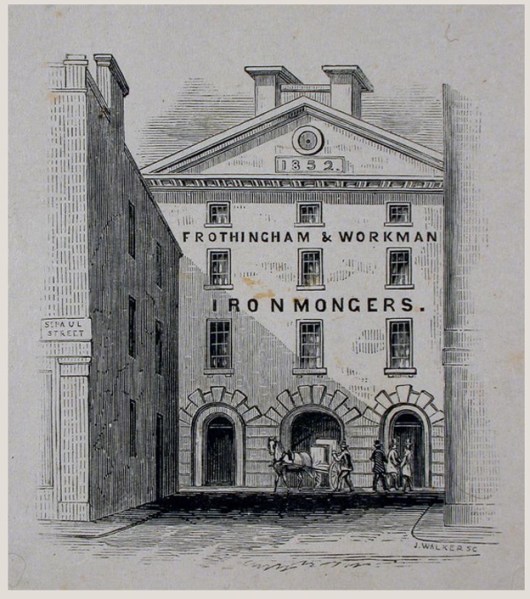
He found employment with a hardware firm, Frothingham & Co., and within a few years he became a partner. As of 1836, the company was known as Frothingham and Workman, and it became the largest wholesale hardware company in Canada, selling scythes, shovels, augers and nails. When William retired from the hardware business in 1859, his brother Thomas took over running the company.2

Frothingham and Workman, Iron Mongers, Montreal, John Henry Walker, McCord Stewart Museum online collection, M930.50.7309, accessed Jan. 6, 2026.

Montreal was growing rapidly, and William found opportunities to invest in fields such as banking, transportation and real estate. William was elected president of the City Bank in 1849 and served in that capacity until 1874.3 In 1846 he was one of a group of prominent Montrealers who founded the City and District Savings Bank, established to help ordinary people save their money, and he was president of that institution for several years.

William invested in Canada’s first railway, the Champlain and St Lawrence, completed in 1836 to connect Montreal to Saint-Jean on the Richelieu River.4 He was also a shareholder in the St. Lawrence and Atlantic Railroad, and he collaborated with several other individuals to found the Canadian Ocean Steam Navigation Company in 1854.

Around 1850, he and a business partner became real estate developers. They bought a piece of land south-west of Montreal’s city limits, near the Lachine Canal. The canal attracted industries such as brass foundries and rolling mills, and nearby manufacturing facilities belonging to Frothingham and Workman employed hundreds of people. The partners laid out streets, built sewers and divided the property into housing lots. The area, known as Sainte-Cunégonde, became a village in 1876 and a tiny independent city in 1890, but eventually it became part of the City of Montreal.5 Workman Street, named after William, still exists in the area.

William was also a generous philanthropist. He was president of the St. Patrick’s Society at a time when that organization was involved with both the Roman Catholic and Protestant communities. Later, he supported the Irish Protestant Benevolent Society. In 1864, he helped create the Montreal Protestant House of Industry and Refuge, serving as president from 1874 to 1877. He was also president of the Montreal Dispensary and Hospital for Sick Children.

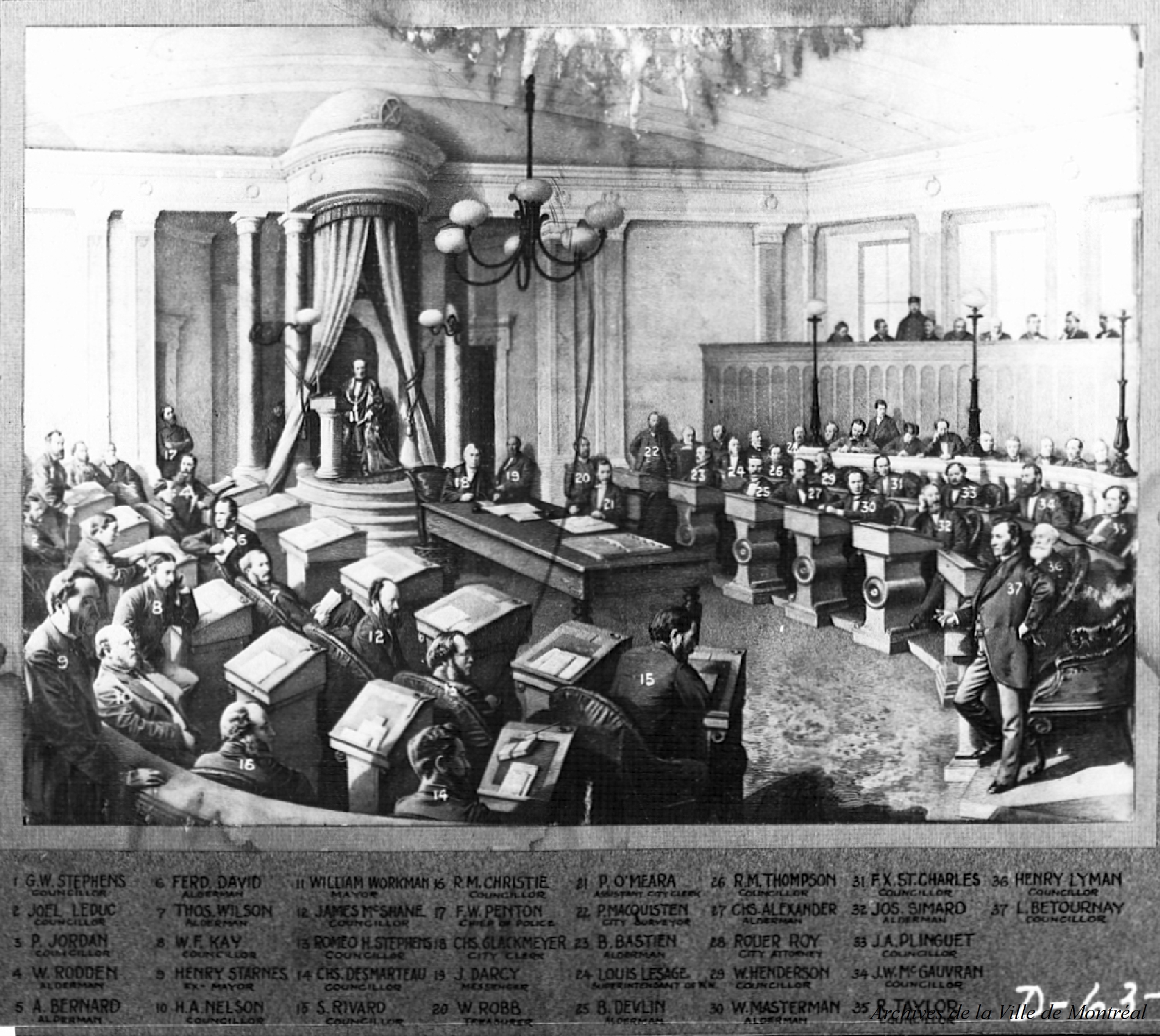
He was not deeply involved in politics, but he was elected mayor of Montreal from 1868 to 1872 and proved to be very popular. This aspect of his life will be the topic of another story.

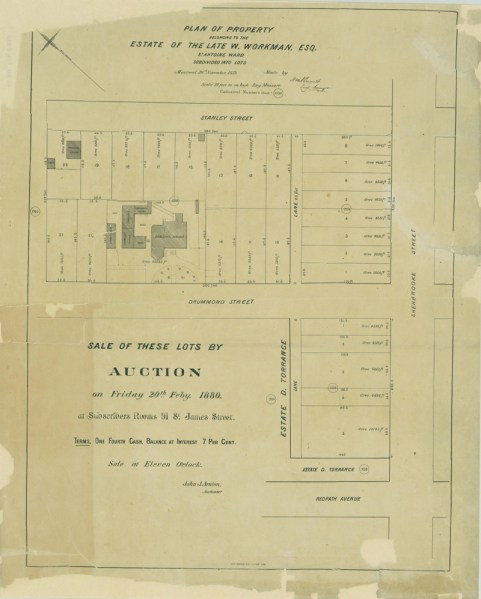
Around this time, wealthy merchants began building large homes on the slopes of Mount Royal, an area that became known as the Golden Square Mile. William bought a full block on the north side of Sherbrooke Street, between Drummond and Stanley, and built a mansion he called Mount Prospect.

“Plan of property belonging to the Estate of the Late W. Workman Esq. subdivided into lots.” H.M. Perrault, 20 Novembre, 1879; Bibliothèque et Archives nationales du Québec, entry for William Workman, https://numerique.banq.qc.ca/patrimoine/details/52327/3394052?docsearchtext=William%20Workmanaccessed 6 January 2026.

William Workman and Elizabeth (Eliza) Bethell were married at St. Paul’s Presbyterian Church on February 10, 1831. Eliza came from the same part of Ireland where William had grown up, so perhaps they had known each other there. They had seven children, so the house should have been full of activity, but it didn’t turn out that way.

It was all too common for children to die young in 19th century Montreal, and William and Eliza lost three little ones. Their firstborn, Elizabeth, was born in December 1831 and died the following summer. Their third child, Emma, was born in August 1837 and died in April 1839. Another girl, Malvina, was born in July 1845 and died in April 1847. Two daughters, Louise (or Louisa) and Elizabeth (Eliza), grew to adulthood, but Eliza, who married Robert Moat, died in 1871. Louisa married Joel C. Baker, a lawyer who went into the hardware business with Louise’s uncle Henry Mulholland.

But William found the death of his only son, also named William (1840-1865), the most devastating blow of all. By then, he and his wife may have already been living apart.

An image of the 1861 census suggests that Eliza was not living at Mount Prospect house, but with her married daughter Louisa Baker and her husband,6 so perhaps William and Eliza had unofficially separated by then. In the 1871 census, seven people were listed as living at Mount Prospect, including a cook, a coachman and a horseman. William was the only family member listed.

In a book about William’s brother, The Father of Canadian Psychiatry, Joseph Workman, author Christine Johnston remarked that Joseph did not have a high opinion of William, commenting in his diary that he thought Wiliam had damage in his head, as well as bumps outside it.7 Perhaps William was also concerned about his own mental health: Johnson wrote that William visited a phrenologist in the United States to examine those external bumps. Johnston also noted that family records suggested William was an alcoholic. If true, that might explain the difficulties in the Workman household.

Nevertheless, many people admired him. When he died, Montreal’s English-language newspapers published extensive obituaries, describing William’s many accomplishments as well as the long and painful illness that led to his death.8 According to one newspaper account, some 400 people attended his funeral at St. James the Apostle Anglican Church, and many followed the hearse to Mount Royal Cemetery.

Wiliam Workman seemed to have everything, but without his family surrounding and supporting him, his life appears to have been a sad one, and those problems followed him to the grave.

The article is also posted on my personal family history blog Writing Up the Ancestors.

Notes

William’s sister Ann (1809-1882), who married hardware merchant Henry Mulholland, was my great-great-grandmother.

Some photos of brother Thomas Workman’s house on Sherbrooke Street are erroneously identified as William’s house. I have not found a photo of Mount Prospect.

There are several photographs of a young man identified as William Workman in the McCord Stewart Museum’s online photo collection. This must the son who died in 1865.  

Phrenology was a popular pseudoscience in the 19th century. Its proponents believed that the measurements of the skull were indicative of mental faculties and character traits.

Sources:

1.   Christine Johnston. “The Irish Connection: Benjamin and Joseph and Their Brothers and their Coats of Many Colours,” CUUHS Meeting, May 1982, Paper #4, p. 2. 

 2.  John Frothingham, Obituary. The Portland Daily Press, May 24, 1870, p. 3. Newspapers.com, accessed Jan. 5, 2026.

3. Nicholas Flood Davin, The Irishman in Canada, London: S. Low, Marston, 1877, p. 334, Internet Archive, https://archive.org/details/irishmanincanada00daviuoft/page/334/mode/2up accessed Jan. 5, 2026.

4. G. Tulchinsky, “Workman, William,” in Dictionary of Canadian Biography, vol. 10, University of Toronto/Université Laval, 2003–,  https://www.biographi.ca/en/bio/workman_william_10E.html

5. Olivier Paré, “Les bâtisseurs de la Petite-Bourgoyge” Encyclopédie du MEM, https://ville.montreal.qc.ca/memoiresdesmontrealais/les-batisseurs-de-la-petite-bourgogne5 accessed Jan. 5, 2026.

6. Ancestry.ca, 1861 Census of Canada. entry for Joel C. Baker, Canada East, Montreal. Library and Archives Canada, Canada East Census, 1861, p. 4210. accessed Jan. 6, 2026.

7. Christine I. M. Johnston, The Father of Canadian Psychiatry: Joseph Workman, Victoria: The Ogden Press, 2000, p. 122. 

8. “Late William Workman”, The Gazette, Feb. 25, 1878, p. 2. Newspapers.com, accessed Dec. 30, 2015. 

Christmases Remembered

Christmas 1955

As Christmas approaches, there aren’t visions of sugar plums dancing in my head, but flashes of my childhood Christmases in Montreal in the 1950s and 60s. There were a few green Christmases but mostly there was snow on the ground.

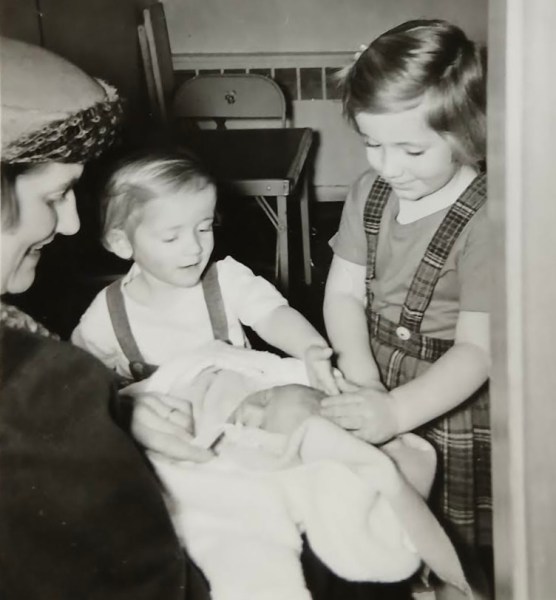
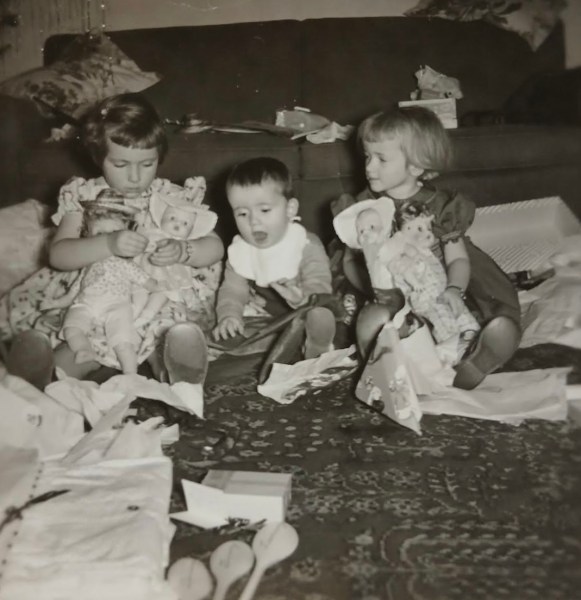
On my second Christmas, I got a baby brother for a present. He was born on December 19th, and in those days, mothers typically stayed in the hospital for a week. The doctor let my mother out a day early, so she came home with Donnie on Christmas Eve. One had to pay for the stay beforehand, so she received a refund!

Christmas Brother


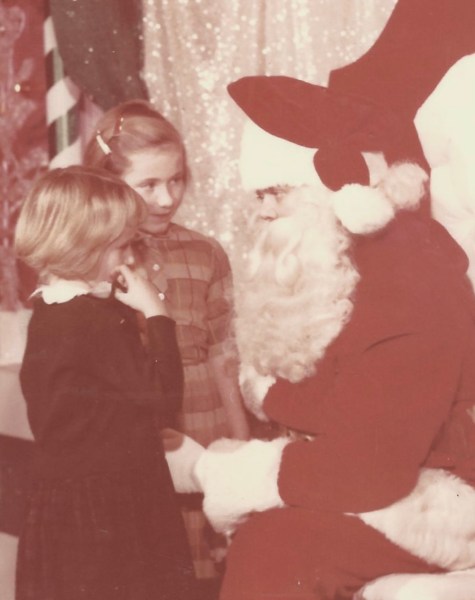
Excitement mounted as Christmas approached. There was the Santa Claus parade, followed by visits to Santa at Eaton’s Department Store, a ride on the little train with a gift, and then lunch in the 9th-floor restaurant. I still remember the sandwich plate, chicken and egg and clown ice cream (a scoop of ice cream decorated as a face with a little ice cream cone upside down as a hat.) My mother would take the children two by two. First, the older ones and then the younger ones. We knew that the real Santa was at Eaton’s because he climbed down a chimney there at the end of the parade.

Visiting Santa at Eaton’s

We didn’t have a television but listened to a show on the radio where a list of good girls and boys was read from the North Pole. Mary was usually mentioned being a common name but not my friend Dilys’s name. One year we watched Amal and the Night Visitors, an opera by Gian Carlo Menotti on TV at my Grandmother’s. Listening to the record every Christmas became a tradition.


As my mother bought presents, she put them in the linen cupboard and locked the door. We knew that the key was on the moulding above. So, a curious child could climb on a chair, unlock the door and check on the presents. As I got older, the anticipation and surprises were better than sneaking a peek.

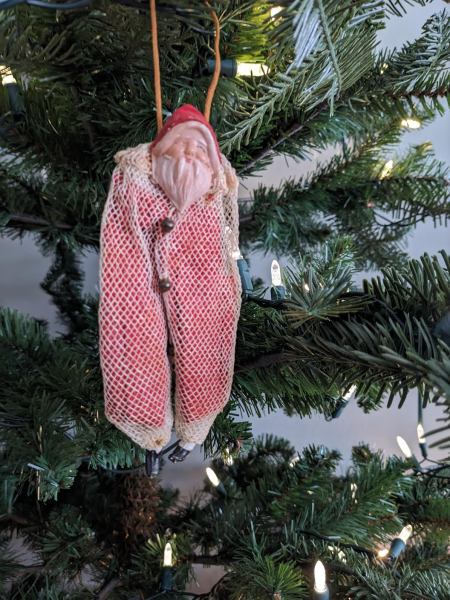
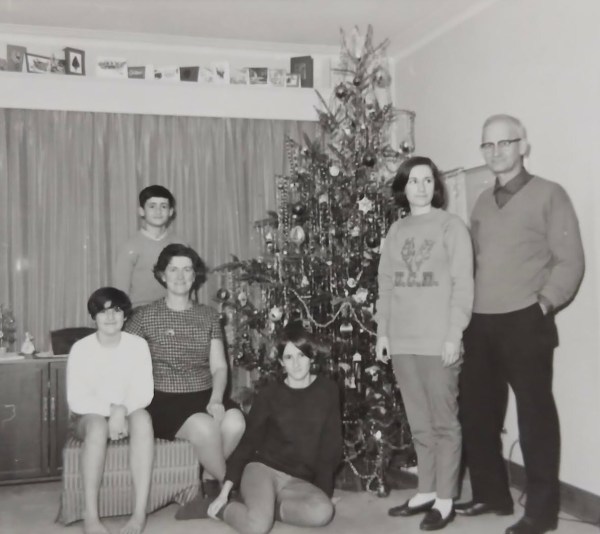
The tree was only decorated a day or two before Christmas. Dad would set up the tree and add the lights. My mother would always put on the tinsel, not throwing on handfuls but putting pieces on one by one, as her father had done. We could put on some ornaments. We had some large fragile balls and lights that had bubbling red liquid and everyone’s favourite Sack Santa.

Sack Santa

We could ask Santa for only one thing, as he needed to have presents for all the good boys and girls. That present came unwrapped. Mrs Claus didn’t have time to wrap all the toys. We could play with our Santa present while Mom made breakfast.

We made and bought presents for aunts and uncles. One Christmas I made sachets embroidered with branches and filled with spruce needles for the aunts. My brother once gave everyone a comb from the big package he bought. One uncle was a teacher and he always got a red pencil.

My father didn’t cook but every Christmas he would make chocolate fudge for his Aunt in Toronto.

The years we were in the Junior Choir, we sang at the midnight service. Snowy Flakes are Falling Softly, was a favourite carol. This was a special event as we got to stay up really late. My parents probably didn’t mind tired children, as perhaps we slept in a little on Christmas morning.

What did Mom want for Christmas? Maybe a paring knife or a new wooden spoon. Now I understand her not wanting more stuff.

This Christmas my mother received three wooden spoons.

We didn’t rip into the presents because Mom saved the larger pieces of wrapping paper and ribbons for the next year. We tried to make the opening of presents last but no matter how large the pile of presents was, it was soon demolished.

We were usually six plus Grandma on Christmas day. We had dinner at 1:00 pm. For a few years we went to Chateauguay in the evening, to my mother’s sister’s house because Grannie and Grandfather were there. They preferred a quieter Christmas with fewer children! In later years we often had friends or colleagues who were alone over for dinner.

One Christmas, we were going to spend it at our cottage in the Laurentians, north of Montreal. Dad went up and turned on the heat, then a huge snowstorm prevented us from going. A long, unplowed road led to the house. Later, he had to go back and turn off the heat. We never attempted this again and continued with our traditional Christmases.

Merry Christmas to All!

Notes:

Another Christmas Story

https://genealogyensemble.com/2021/01/20/sugarplum-tree/

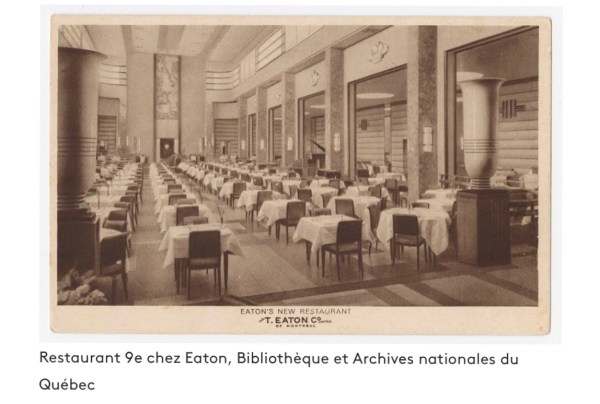
Eaton’s department store on Saint Catherine Street in Montreal was a destination. It was one of three department stores, the others being Morgan’s, which became The Bay and Simpson’s. The restaurant on the 9th floor was opened in 1931. It was in Art Deco style, inspired by the dining rooms of luxury ocean liners. After Eaton’s went bankrupt in 1999, the restaurant remained locked up for a quarter-century. It reopened in 2024, restored to its original style. The dining room has been converted into an event space, with a restaurant located in the outer corridor.

The dining room in its former glory

Snowy Flakes are Falling Softly https://www.youtube.com/watch?v=svfu6WcIh84

Amahl and the Night Visitor by Gian Carlo Menotti

My Grandpapa and the Greeks

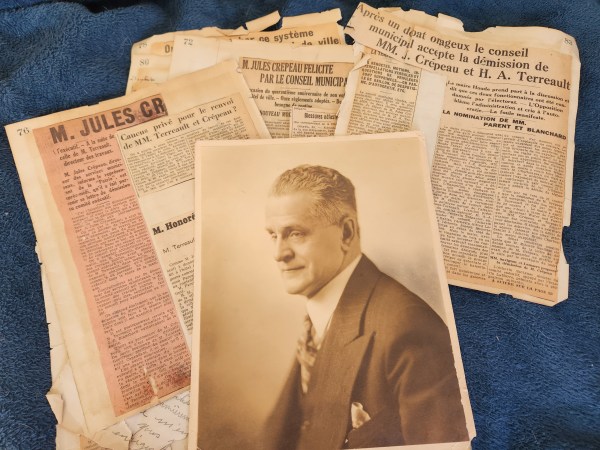
Pages from the WWI era scrapbook my Aunt Flo kept. (I threw out the cover as it was shedding).

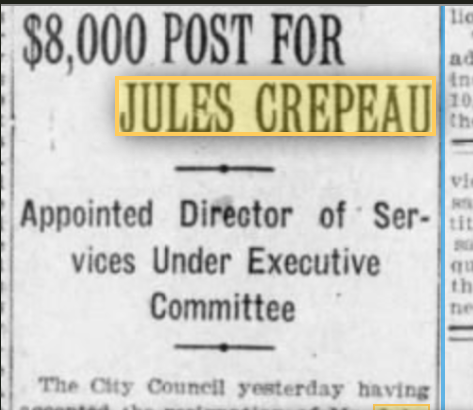
My mom liked to tell me that her father, Jules Crepeau, started work at eight years old in the 1880’s sweeping the floors at Montreal City Hall and that by the Roarin’ Twenties he had risen to be the highest paid civil servant in the city.

This family myth spoke volumes to me: my grandfather was a self-made man and a man of the very highest calibre.

By 1921, when my mother was born, Jules was Director of City Services responsible for just about everything that came down in the city, from the Prince of Wales’ official visits to damage control during typhoid epidemics to the handing out of liquor licenses in the Prohibition Era

All seven city departments were under his control, including and most significantly, the Police Department. My mother said that my grandfather occasionally brought her to work at City Hall. This must have made quite a huge impression on her.

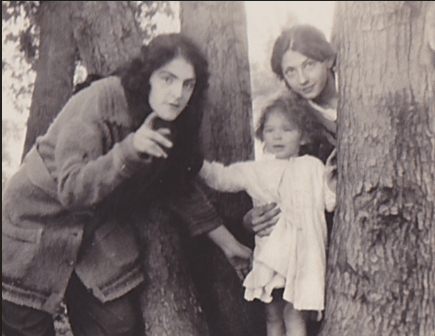
My aunts Alice and Flo and my mom, circa 1922.

My grandfather’s City Hall file reveals that he started out young as an intern in the city Health Department in 1888 and by 1901 he had worked his way up to the position of Second Assistant City Clerk, * aka the person who sees all the paperwork that passes though City Hall.

Jules had complete recall so this was a useful learning experience. In 1921, he landed that plum post of Director of City Services, a new position set up specifically to ensure an even distribution of municipal assets across the wards. Before the post was created, community groups from across the spectrum were invited to give their input on the subject.

I have since learned that Montreal’s burgeoning Greek community most probably had a hand in his promotion.1

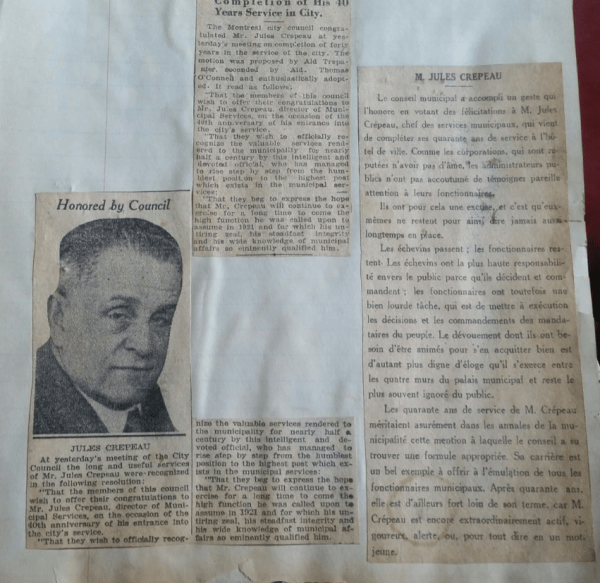
A few years after my mom died in 2009, I took a closer look at a disintegrating family scrapbook my Aunt Flo had kept. It contained yellowed news clippings from 1928 and 1930. In 1928, my father was being applauded for his 40 years of stellar service at City Hall. In 1930, he was being forced out by new Mayor Camillien Houde.

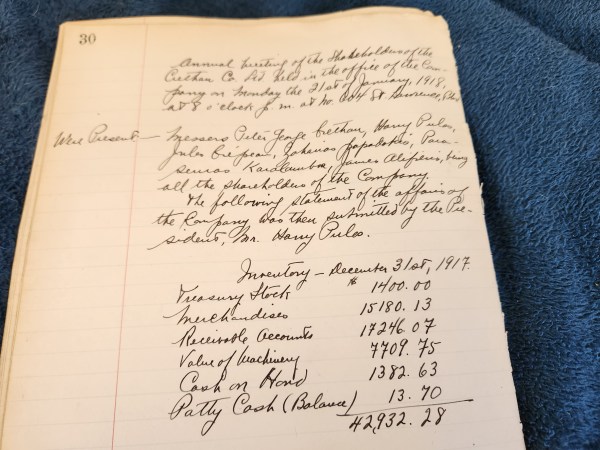
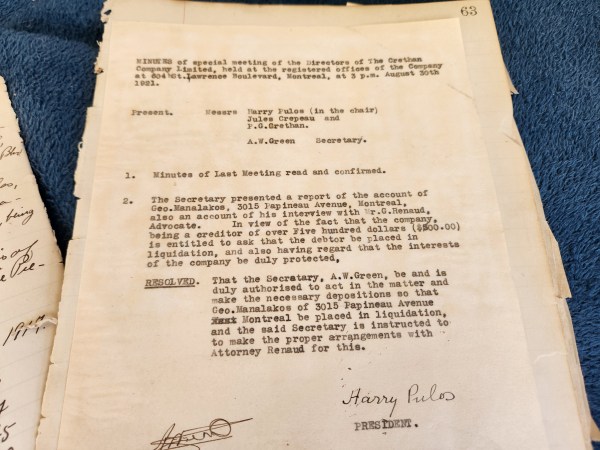
I noticed that the dilapidated black volume had originally been a minute book for The Crethan Company, a confectionery/food distribution company run out of Clarke Street by a handful of Greek men as well as my grandfather.

1917 minutes. Crethan Company. The company distributed food, olive oil, fruits, confections. Likely supplying Greek restaurants.
oops. Someone didn’t pay their bills

The President was Harry Pulos aka Harambolous Koutsogiannapoulos, the defacto leader of the early Greek Community in Montreal.2 How interesting.

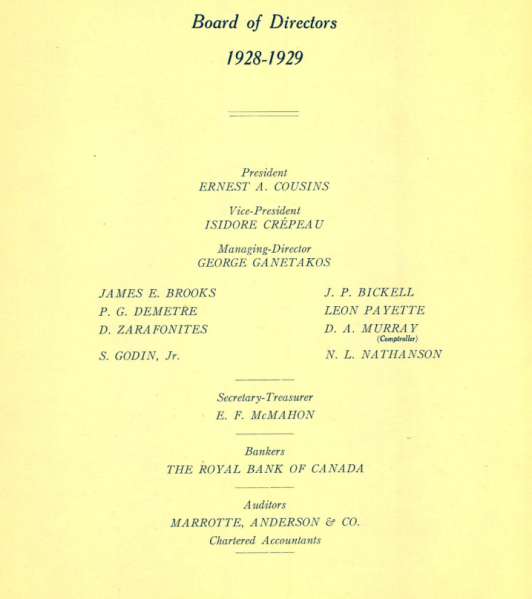
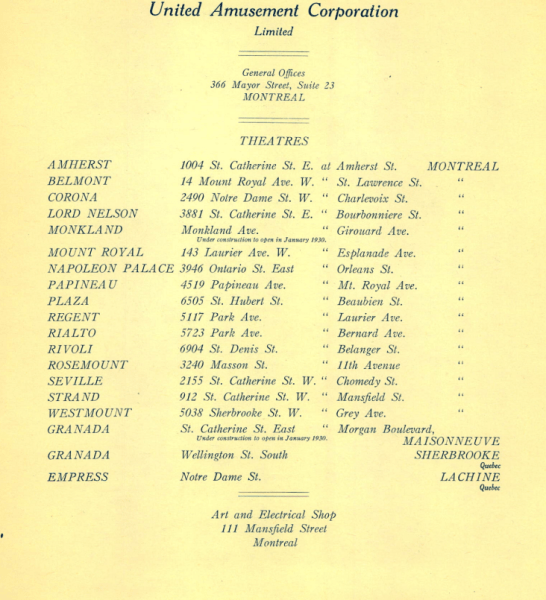
You see, by that time, I had researched my genealogy and discovered that my mom’s Uncle Isadore Crepeau had been VP of United Amusements, a movie distribution titan founded in the 1910’s by Laconian immigrant George Ganetakos. Ernest Cousins, an Anglo businessman was President..

So, I checked to see if these two men, Harry Pulos and George Ganetakos, were related: the answer is very likely.3

My mother had never mentioned her father’s Greek connections, not once, but she did talk about working in the Montreal movie biz before she was married.

In 1941, right out of Marguerite Bourgeoys secretarial school, my mom got a job at RKO Movie Distribution, a United Amusements affiliate.4 Both companies were located on Monkland Avenue in Notre Dame de Grace, near her family home at the corner of Oxford and Monkland. (LINK to story I Remember Maman)

Taking an even closer look at the Minute/Scrap Book I suddenly noticed the significance of the dates. The Crethan Company was started in 1916 and ran until (at least) 1922 when the minutes end.

Honored by council in 1928, thrown out in 1930.

Grandpapa Jules seems to have aligned himself at just the right time with these ambitious men from Laconia. They probably helped him land his prize post and, in turn, he helped them with motion picture and restaurant licenses. 5I can’t prove it, but Jules almost certainly got his brother Isadore, an insurance salesman, his gig as VP of United Amusements.

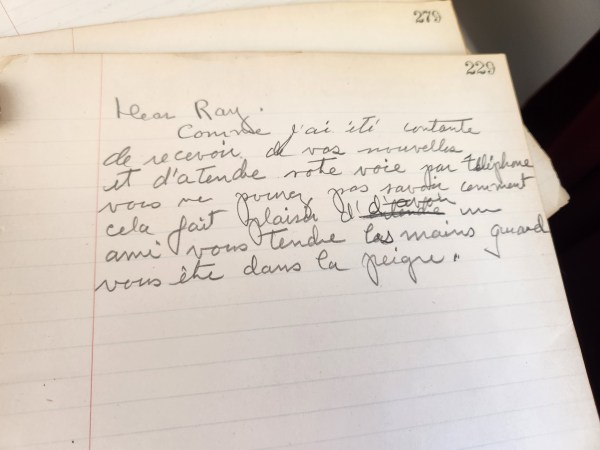
How did this get in there? A weird letter, likely my Aunt’s with spelling mistakes.
Dear Ray. How happy I was to receive your news and to hear your voice by telephone. .you can’t imagine how nice it is when a friend extends his hands when you are ‘dans la peigre.” Does she mean piege as in trap.Pegre as in underworld. If she meant Pegre, is she using a metaphor for ‘being grounded’ or does she truly mean ‘in the underworld?

In 1927 came the fatal Laurier Palace Motion Picture House Fire, where 78 children perished in a crush to the door. It was a real game changer in Quebec, and my grandfather got caught smack in the middle. He was blamed for looking the other way when citations were given to movie houses for letting in children unaccompanied by an adult.

George Ganetakos, using the name George Nicolas, immediately set up a fund for the victims. During the inquest my grandfather brought in Earnest Cousins to plead for continued Sunday showings. Isadore also spoke. Sunday showings for adults were allowed to continue.

As it happens, two years before in late 1924 during an inquest into organized crime, corrupt policemen and Montreal’s sex industry, a cop-on-the-take took the stand and accused the Greeks of “corralling” children into movie houses and warned, “one day there’s going to be a fire and no one will be able to get out.” He wasn’t even being asked about movie houses: He brought this up out of the blue. I suspect this cop was a go-between and he was sending a coded message to my grandfather.

My grandfather certainly thought so. He had that same policeman fired the very next day.

Top: 1929 annual report United Amusements. Isadore would ‘fall’ out of his 7th story office window in 1933. Bottom: movie houses owned by UA. The list of these movie palaces would grow. My Great Uncle Isadore was shown on a talkie film at the opening of the Monkland Theatre. Isadore’s glass company would make a mural to adorn the Rivoli. It’s still there today. (Mcgill digital archives.) N.L. Nathanson, an American was in Toronto, head of Famous Players. The two companies were associated.

My grandfather, in turn, was ousted in 1930 by the new Houde administration, but not before negotiating a huge life pension, likely in exchange for his silence. In 1937, during the Depression his hefty pension was rescinded by City Hall as an emergency measure – and just two weeks later my grandfather got run over by a plain clothes policeman near his home in NDG. Hmm. He spent 3 months in hospital and died the next year of complications at the age of 59.

My opinion only: Obviously my grandfather had nothing to do with the fatal fire, but his enemies may have had a hand in it.

The Laurier Palace was owned by Syrians, a group that was often conflated with Greeks back in those days.

Funny, whenever I’d ask my mom why I couldn’t go to the movies as a child she would tell me the story of ‘all the little babies who died in the Laurier Palace Fire’ and she’d pretend to rock an infant in her arms.

She didn’t know the real story.

The End

  1. L.O. David, the patrician head City Clerk, was a scholar who preferred working on his history books over the bureaucracy of City Hall. My eager-beaver grandfather got to do all the work! Montreal had universal male suffrage, but in the century earlier Montreal was an English majority city and the Mayors had to have 10,000 dollars in the bank just to run and the aldermen had to have 2,000 dollars and be fluent in speech and writing. They abolished these rules in and around 1910 as the city grew, absorbing the suburbs. The city became majority French. They also abolished the rule that an English Mayor must follow a French Mayor. Populist mayors, petit bourgeois, were now elected instead of the well-educated professionals of the Victorian Age. It must also be noted that the post of Mayor became less and less powerful, almost a figurehead in the 1920’s with the Executive Committee having all the sway. 1910 saw an immigration boom, so there were important votes to be had among these newcomers.
  1. To Build the Dream, Sophia Florakas Petsalis. 2000 explains that Koutsagiannopoulos was a pre-turn of the twentieth century arrival who had a fruit store across from where Eaton’s would be built, a highbrow location. Phillip’s Square was so ritzy, it was one of the few areas female students from Royal Victoria College up on Sherbrooke, were permitted to venture. According to the book, Pulos made sure to take care of his fellow Laconians, finding them jobs upon landing, etc. Other names on the board: Pappas, Antoniou; Economides; Crethan, Pappadakis, Karalambos and at one point a Forget.
  2. Drouin (Greek EvangelizmosChurch Montreal) reveals that in 1907 a Zarafonity from Dourali Laconia married a Koutsgiannopoulos- a marriage witnessed by Ganetakos, also from Dourali. He likely had a Zarafonitis mother. Koutsogiannopoulos also was godfather to John Zarafonity son.
  3. Lovell’s Directory reveals this fact. She lived on Monkland and Oxford with her Mom and brother and sisters. Her dad died in 1938.

Greek men (mostly from Laconia, many related),were involved in all aspects of the movie distribution industry in Montreal back in the day. Ganetakos was only the most prominent of these movie men. The Syrians who were conflated with Greeks in the newspapers might have been Pontic Greeks from Turkey.

These new Canadians often started out working in the food industry, often pushing carts through the streets, then starting up stalls and then expanding into stores, cafes and restaurants.

The story goes that Ganetakos’s uncle, Demetre Zarafonitis, started playing ‘flickers’ at his fancy uptown café, the Cosy Parlour near Phillips Square, and that George noticed these early movies were more popular than the ice cream.So he started up his own motion picture house, the Moulin Rouge in 1908.

Two decades later, George Ganetakos was working out of his palatial office on Monkland Avenue, distributing Hollywood films for Famous Players and RKO, building architectural masterpieces like the Rialto Theatre on Park Avenue, and getting lots of press in the Hollywood trade journals. (My grandfather got a fair bit of press there as well.)

It seems that George Ganetakos was as much of a self-made man than my grandfather. However, I had contact with a descendant of the Zarafonitis’ and she was told her ancestors got the bum deal.

Greeks were referred to as Syrians in the press and they faced obstacles to their success by established merchants. People complained the cart pushers yelled too much on the street. At one point, the city wanted to tax stall merchants 200 a year as they did regular stores. An alderman, one loyal to my grandfather, spoke up for them saying this would force them out of business.

  1. During the Coderre Inquiry into Police Malfeasance in 1924, a policeman on the stand said that Jules personally forced policeman to look the other way when it came to underage clients of movie houses. He also said Greeks ‘corralled’ young children into the movie houses. He brought this up out of context. No one cared about children and movie houses. In those days, across North America, Sunday showings were often an all- kid affair. (The parents got an afternoon off). And besides, the streets at that time were dangerous with horses and autos running amok with no street rules. The Inquiry was about illegal booze and, mostly, the sex trade. In Juge Coderre’s final report in 1925, published in the Gazette and other places and rehashed for a 1926 US Senate hearing into Prohibition, the testimony getting into a two page spread in the New York Times, Coderre imperiously asked, “Who is this man Jules Crepeau who tells the Chief of Police what to do?”

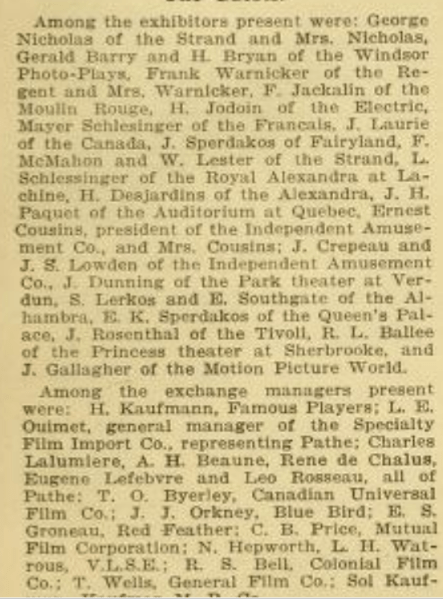
A strange bit from a May 20,, 1916 Motion Picture World with the guestlist for a bash in honor of a Pathe movie star in town written by a Gazette reporter. Seems to show my Grandfather J. Crepeau with Ernest Cousins of “Independent Amusement”. Is this a typo, supposed to be I for Isadore? Either way a mystery. Did my grandfather dip his toe into the movie business as well as the food business in 1916? Or did Isadore have the movie gig as early as 1916? George Nicholas at top is likely George Ganetakos. (I have to delve deeper. I believe Indepent Amusement became United Amusements.) And is the T Wells my husband’s grandfather? See all the Greek names? Sperdakos, Lerakos etc. and M. Ouimet of the legendary Ouimetoscope.

Dec, 1921.

James’ Tragedy

Suicide is a tragedy that leaves a deep and lasting scar. On an April day in 1864, James Hunter, 45 years old, my second great-granduncle, decided to throw himself in front of a train. All the sadness of this event is illustrated in James’ father’s registration of the death described as “accidentally killed on Monkland Railway by the engine.”1 The newspaper article is more direct, “Hunter threw himself in front of the engine.”2 Understandably, James’ father probably rewrote history to get through his pain of registering such a sad event. He also possibly wanted to avoid further pain for the family as a result of a suicide in the family.

In 1864, sudden deaths would have usually be referred to the Procurator Fiscal, known in other jurisdictions as the public prosecutor. There is no entry on the registration of death to indicate that the Procurator Fiscal held an inquiry into James’ death. They may have deemed it not necessary, as it was obviously a suicide. While committing suicide was considered a crime in 19th century England and Wales, this was not the case in Scotland. Citizens were free to take their own life, but it was assumed they would be answerable to God. In England and Wales, suicide was decriminalised only in 1961 with the passing of the Suicide Act. Prior to this, anyone who attempted suicide could be imprisoned and if they were successful and died, their families could be prosecuted. 3

James was born around 1819 and possibly in a colliery. James, like his father, was a coalminer. When he committed suicide he left behind his wife, Elizabeth Pettigrew, 4 and seven children.5

At the time of his death, James lived in Coatbridge, a village in North Lanarkshire in Scotland. Coatbridge is about 8 km north of Glasgow. James lived in Brewsterford, an area of Coatbridge that was close to the Calder Iron Works. It is therefore no surprise that James chose to end his life within walking distance of his home.6 The train of the Monkland Railways was at a level crossing at the Calder Iron Works when the locomotive engineer spotted James. Sadly, it was too late for the engineer was unable to stop the train in time to prevent the tragedy.7

Map of Calder Iron Works, 1859, Scotland’s Brick and Tile Manufacturing Industry

Of course, no one can know why James committed suicide or at least there is no official record of why. The newspaper article indicates that he had been “dull and melancholy for some time past.” 8 We can guess that he was clinically depressed. His family and loved ones would have noticed but, unlike today, would have had no way to help him overcome his depression.

All suicides are a tragedy. It would have been catastrophic for Elizabeth and her seven children. Added to the shame and stigma of suicide, Elizabeth would have lost the breadwinner of the family. The older children were on their own by then but the four youngest ones were still in school.

  1. Scotland’s People, Statutory Registers of Death, 1864, Deaths in the District of Old Monkland in the County of Lanark, 21 April 1864, James Hunter, accessed 23 October 2025.
  2. The Herald Glasgow Edition, Strathclyde, Scotland, 26 April 1864, page 3, accessed 23 October 2025.
  3. Wikipedia, Suicide Act 1961, https://en.wikipedia.org/wiki/Suicide_Act_1961, accessed 28 May 2024.
  4. Scotland’s People, Old Parish Registers of Marriages, 1839, Airdrie or New Monkland, James Hunter and Elizabeth Pettigrew, accessed 7 November 2025.
  5. Ancestry, family trees, children not double checked.
  6. Map of Calder Iron Brickworks, Scotland’s Brick and Tile Manufacturing Industry, https://www.scottishbrickhistory.co.uk/calder-iron-brickworks-whifflet-coatbridge-north-lanarkshire/, accessed 1 December 2025.
  7. The Herald Glasgow Edition, Strathclyde, Scotland, 26 April 1864, page 3, accessed 23 October 2025.
  8. The Herald Glasgow Edition, Strathclyde, Scotland, 26 April 1864, page 3, accessed 23 October 2025.

The Man Behind the Black Cross Temperance Society

What made my ancestor think of using a black cross to mark homes of temperance?

Edouard Quertier (Cartier) launched Quebec’s first official temperance society in 1842 by placing a giant black cross on the top of the escarpment in Saint-Denis-de-Kamouraska. So began an organization that would encompass 400,000 of 900,000 Canadian Catholics eight years later.(1)

The symbol created a tradition that continues in Quebec to this day. If you ever go into a home with a bare black cross hanging in the middle of the living room wall, you’ll know you’re in the house of people who do not drink alcohol.

But what gave him the idea?

1842 Arrival in St Denis

Quertier certainly wasn’t feeling inspired when he first arrived in the tiny hamlet or between 10 and 15 families at the edge of a cliff on the Saint Lawrence’s south shore.

How did I accept this arid rock?,” he wrote. “When I arrived [in October], there was not even a piece of board on which to place a bed or a table. I had to go down the slope and rent a small house, or rather a cabin. No matter! I waited there, until my lodging was acceptable.”(2)

Still, Quertier was no youngster when he arrived in Saint-Denis-de-Kamouraska. At 43 years old, he had had four previous jobs before his priesthood and 12 years of experience serving communities.

Le révérend Édouard Quertier, 1864, Fonds J. E. Livernois Ltée, http://numerique.banq.qc.ca/patrimoine/details/52327/3114297

Previous Jobs

Both of his previous roles as parish priest were stressful.

As curate and then parish priest of Saint-Antoine in Montmagmy, he argued frequently with his patron, Father Charles Francois Painchaud.

His bishop got him out of that situation by appointing him parish priest of Sainte-Georges of Cacouna. There, a new church and presbytery were required, but building them was difficult due to arguments between residents who wanted religious leadership and those who believed in the strong separation of Church and State. Despite the conflict, Quertier was able to build a new church and presbytery within the village. He oversaw the presbytery stonemasons and carpenters and got the church walls well underway before resigning the post. His departure halted the building of the church for a time, but it resumed in 1845 and opened for worship in 1848. The belfry didn’t get added until 1892 and full consecration delayed until 1897, but that’s another story.(3)

The experience simply makes clear that Quertier knew he had to do something important quickly to make an impact on his new neighbourhood.

He decided to promote temperance as a movement.

Temperance in Quebec

The issue already had some momentum in Quebec. Popular people like Bishop Charles-August-Marie-Joseph de Forbin-Janson and Charels-Paschal-Télesphore Chiniquy had been telling stories about the evils of alcoholism in weekly masses since 1839. Community residents saw that frequent imbibing often led to fighting, lethargy, poverty, spousal abuse, theft and neighbourhood violence.

Unlike his predecessors, however, Quertier decided to formalize the movement with an official association he called “The Society of the Black Cross.” He created statutes, oaths for members and procedures for joining the society, including the requirement that each member display a plain black cross on the wall of the family living room.

For the next 15 years, Quertier’s campaign for temperance spread. So many French Canadian families displayed the black cross, it became a decor tradition. The Quebecois de Souche society includes a photo that shows the once prevalent look.(4)

Growth and Departure as Leader

In the meantime, Quertier continued building his parish. The wooden chapel that originally opened on December 24, 1841 got replaced by a stone gothic church in 1850.

Seven years after that, Quertier retired. By then, the Society of the Black Cross included believers in almost every parish in Quebec and Quertier’s own parish had grown to encompass 100 families containing “625 souls.”(5)

Temperance continued to be a key issue, not only in Quebec but across Canada. In Quebec, however, the secularism movement also had great strength in many communities. To avoid angering these groups, the Province of Canada passed the Canada Temperance Act that allowed any county or city to hold referendums to consider whether or not to forbid the sale of liquor. This would ensure that communities who wanted to stay dry could do so without forcing prohibition on the entire country.

Life after Death

Quertier spent the rest of his life in Saint-Denis-de-Kamouraska, which became Saint-Denis-de-la Bouteillerie in 2013. After his death in 1879 at 73 years old, the church entombed his body under the crypt of the church. A tombstone says in French:

Here lies lord Edouard Quertier, first parish priest of St. Denis, one of the first apostles of temperance. Died July 17, 1873, aged 73 years, 10 months, 12 days. For 15 years, he lived for you. Pray for him.”(6)

Quertier’s remains continued to draw enough visitors that the church got entirely rebuilt after a fire damaged it on March 9, 1886. Initially, they built a belfry to hold a 2027-pound bell that cost $425,000 the following spring, and new walls on those of the former church by October. Later, they’d add two more bells to the tower.

Quertiers’ campaign for temperance didn’t end when he died. Members of his Black Cross Society were among 20% of Quebec’s population that supported a federal referendum on prohibition in 1898.
The movement grew substantially during World War I.

Temperance, not Prohibition

The Quebec Government declared prohibition in 1919. Then it made several exceptions by legalizing the sale of light beer, cider, and wine in hotels, taverns, cafes, clubs and corner stores.

The prohibition law got repealed entirely to enable liquor sales through a government-run commission in 1921.

In many ways, by choosing control over strict adherence to abstinence, the government duplicated the practicality Quertier included within the original functioning of the Society of the Black Cross.
Any household that became a member of the temperance organization could get a special dispensation to serve alcohol during celebrations, such as baptisms, birthdays and weddings. If the parish priest agreed that a special occasion merited an exception, he would temporarily replace the plain black cross in a home with a white one. The white cross hung on the wall during the celebration. After the celebration ended, the priest would visit to exchange the white cross with a black one and return the home to a liquor-free location.(7)

This kind of flexibility enabled temperance to continue growing within Catholic communities in Quebec even after 1921. Some of its proponents resurrected Quertier in the form of a statue in front of his former church in 1925. The statue remains in place today.

Sources

(1) Ferland, Jean-Baptiste Antoine, in a report to the Holy See, 1850 as written in section 8, part 98 of Canada and its provinces, edited by Adam Short and Arthur G. Doughty, Glasgow, 1914, https://archive.org/stream/canadaitsprovinc11shoruoft/canadaitsprovinc11shoruoft_djvu.txt, accessed July 19, 2020.

(2) Julienne Barnard, “QUERTIER, ÉDOUARD,” in Dictionary of Canadian Biography, vol. 10, University of Toronto/Université Laval, 2003–,written in 1972, http://www.biographi.ca/en/bio/quertier_edouard_10E.html, accessed on July 18, 2020.

(3) Ouellet, Jean-Baptiste, Municipalité de Saint-Denis-De La Bouteillerie. https://munstdenis.com/municipalit%c3%a9/historique/, accessed July 18, 2020.

(4) Fédération des Québécois de souche, https://quebecoisdesouche.info/la-croix-noire-croix-de-temperance/, accessed July 18, 2020

(5) La Corporation de développement de Mont-Carmel, https://www.mont-carmel.ca/histoire/, accessed July 18, 2020.

(6) Généalogie Abitibi-Témiscamingue, https://www.genat.org/cimetieres/photo.php?idPhoto=2c0bf0249a01fd83b57322e7b7cb3362, accessed July 18, 2020.

(7) Fédération des Québécois de souche, https://quebecoisdesouche.info/la-croix-noire-croix-de-temperance/, accessed July 18, 2020.

Memories of a Bygone Era

Memories of a Bygone Era 

Every year, as the warm summer fades away and the splendour of autumn colours is upon us, my thoughts turn to a specific memory from my childhood. It is almost like clockwork and never fails.  

Mom, Claire and Paul 

circa 1944

When I was about four or five years old, my mom taught me a song that is forever etched in my memory.  

When the trees take on their beautiful fall colours,  and when gentle breezes send brightly coloured leaves of red and gold gently spiralling to the ground, forming, colourful carpets, I am reminded of a song my Mother taught me more than eighty years ago. To this day, I still sing “Come Little Leaves said the wind one day,” when driving along, enjoying the fall season and all its many vibrant colours. This brings back many fond memories of the bygone era. 

Children’s Song 

“Come, little leaves,” 
Said the wind one day, 
“Come over the meadows 
With me, and play; 
Put on your dresses 
Of red and gold; 
Summer is gone, 
And the days grow cold.” 
 
Soon as the leaves 
Heard the wind’s loud call, 
Down they came fluttering, 
One and all; 
Over the meadows 
They danced and flew, 
Singing the soft 
Little songs they knew. 
 
Dancing and flying 
The little leaves went; 
Winter had called them 
And they were content- 
Soon fast asleep 
In their earthy beds, 
The snow laid a soft mantle 
Over their heads. 

“Come Little Leaves” was written by the American poet George Cooper (1838–1927), with music by Thomas J. Crawford. “Come Little Leaves” was written by the American poet George Cooper (1838–1927), with music by Thomas J. Crawford. 

1945: A Year of Endings and Beginnings, at Home and Abroad.

As I approach my 80th birthday, I begin to think about the year I was born. What a year that was, a year of major global transitions and the historical year of my birth. I was fortunate to be born in November of that year, when most hostilities had ceased in the world and my home town.

However, the hardships in Britain and Europe were just beginning. Now, we had to think about rebuilding our shattered lands.

1945. Plymouth, Devon, England, after a Blitz Raid

I have an interest in the ‘Home Front’ events that occurred in Britain during the Second World War, rather than military stories. However, military stories cannot be ignored as 1945 was quite the momentous year in the military and home fronts. Here is a timeline of key events both at home and abroad that occurred in 1945.

January:

World War 2 is in its final phase, even though Germany is in retreat. The British military pressed onward in Germany and Burma. The Battle of the Bulge ended a major German offensive on the Western Front.

It was believed that Plymouth was being singled out for particularly ferocious attacks because it was home to Her Majesty’s Naval Base, Devonport, which was the largest Navy base in Western Europe and the Royal Navy’s repair and refuelling facility. The dockyard was staffed by women during the war, doing what was normally considered to be men’s work, as all the men were away fighting.

On the home front, Britain was impacted by V-2 rocket attacks.

Rationing, especially items like dried and canned fruit, was scarce. The Ministry of Food encouraged households to reduce waste and get creative with recipes. I still practice creating recipes and reducing waste to this day. This story is my 1950 Christmas with rations. Rationing in England lasted until I was 11.

https://genealogyensemble.com/2021/12/29/memories-of-a-1950-british-christmas/

February:

I was conceived!!

Allied bombers begin a major raid on the city of Dresden. Key events in February included the Yalta Conference between the Allied leaders, the beginning of the Battle of Iwo Jima and the final stages of the war in Europe.

The Soviets captured Budapest, Hungary, and also encircled Breslau, Germany (now the modern-day city of Wroclaw, Poland) as Allied forces pushed toward the Rhine in the west.

March:

The 10th British and Allied forces successfully crossed the Rhine, the first time a foreign army had crossed the Rhine since the Napoleonic era.

British forces pushed deeper into Germany with only scattered resistance.

On the 27th and 29th, the final V1 flying bomb fell on Britain.

Remarkable photo of a German V1 fully autonomous early cruise missile hitting the London area in 1945.

April:

1st The Battle of Okinawa continued for 82 days, resulting in heavy casualties for both American and Japanese forces. Japan launched ‘Kamikaze’ attacks against Allied naval forces.

Dr Fritz Klein, an SS doctor, among some of his victims, Belsen, 24 April 1945

Numerous Nazi concentration camps are liberated, revealing the full extent of the Holocaust to the world.

4th Ohrdruf concentration camp, liberated by U.S. Forces.

11th American troops discovered the Buchenwald concentration camp

15th Liberation of the Bergen-Belsen concentration camp, by the British, who found thousands of ill prisoners and corpses.

29th Dachau camp was liberated by U.S. Forces.

Also on the 29th, Adolf Hitler married Eva Braun in the underground bunker.

30th Adolf Hitler commits suicide, shooting himself at the age of 56 years old, whilst Eva Braun takes a poison pill.

German forces, the last fighting force on the Western Front, surrendered en masse.

May:

7th Germany signs an unconditional surrender,

8th VE Day – victory in Europe – Day

On May 7, 1945, Gen. Alfred Jodl signed the surrender of all German forces in Rheims, France. He is flanked by Wilhelm Oxenius (left) of the Luftwaffe and Hans-Georg von Friedeburg, representing Germany’s navy. | AP Photo

23rd Heinrich Himmler commits suicide while in British custody in Lüneburg, Germany.

June:

15th Wartime blackouts ended, and streetlights were turned back on.

The wartime coalition government, led by Prime Minister Winston Churchill, was dissolved, and a general election was held shortly after.

July:

The general election was scheduled to take place on the 5th of July, 1945, the first general election since 1935. However, the results were not announced until the 26th of July, 1945, to allow time for overseas military personnel’s votes to be counted. The Labour Party, led by Clement Attlee, won a landslide victory in the July 1945 election.

August:

The Family Allowances Act was passed to provide financial support to mothers.

15th was Victory over Japan – VJ – day. Celebrating Japan’s surrender after the atomic bombings of Hiroshima and Nagasaki, and the official end to over six years of global warfare

2nd Japan formally surrenders. Now, our country was focused on the return of troops, the beginning of domestic reconstruction and the promises of independence for its colonies.

September:

15th Parades were held in Britain to mark the fifth anniversary of the Royal Air Force’s victory..

16th Hong Kong was reclaimed, ending the four-year Japanese occupation.

The 17th Belsen Trial began for war crimes in Lüneburg, Germany, presided over by a British military court.

18th The Independence of India would be granted “at the earliest possible date”, was announced by Prime Minister Clement Attlee on a worldwide broadcast.

October:

Britain was now fully engaged in the complex aftermath of the Second World War, with the new Labour government pursuing major domestic reforms and the British Army dealing with global instability and the return of war prisoners.

4th An unofficial dock strike began in Britain.

7th The ocean liner SS Corfu docked at Southampton, carrying the first 1,500 prisoners of war to return from Japanese camps in the Far East. Also on the 7th, Rudolf Hess was transferred from Britain to Nuremberg, Germany, to face trial.

The 20th and the 5th Pan-African Congress were held in Manchester, where delegates from across Africa and the diaspora discussed and called for independence from colonial rule, a significant moment in the history of decolonisation.

This month was a period of substantial change as the nation grappled with domestic reconstruction, a new political direction and the challenges of managing a post-war empire and a new global order.

At the end of October, in Palestine, the Jewish Resistance Movement launched the ‘Night of Trains’, a coordinated attack on the British railway network, marking a rise in armed opposition to British authority.

November:

On the 20th, I was born at the Alexandra Maternity Home, below.

At the time, there was no National Health Service (NHS), so no free medical care. I must have been an expensive baby!

The Alex, as it was often called, admitted maternity patients for a period of not less than a fortnight. Fees were charged from 15 shillings (75P) to 42 shillings (£2.20P) per week.. These fees included nursing, food, laundry and all clothing and if necessary, the doctor’s fees. I have no idea of my weight, size or time of birth. Such things were not, unfortunately, recorded.

December:

The government announced its plan for a National Health Service (NHS) to provide free medical care.

1st British military police in occupied Germany arrested 76 Nazi industrialists.

9th, the United States granted Britain a low-interest reconstruction loan of approximately $4.4 billion (US). An additional Canadian loan was for $1.9 billion, scheduled to run for 50 years.

The final payments made in 2006, which settled the debt entirely, were for $83.25 million to the US and $22.7 million to Canada.

Throughout the rest of the year, Allied forces continued to liberate numerous concentration camps, exposing the extent of Nazi atrocities.

In 1945, post-war, Plymouth faced immense devastation from the Blitz, which had destroyed the city’s heart and left thousands homeless. Plymouth was one of the most heavily bombed British cities, due to its status as a major naval port with the large HMNB Devonport dockyard.

The city centre, two main shopping areas, almost all civic buildings, 26 schools, 41 churches, and 3,754 houses were destroyed, with a further 18,000 properties seriously damaged. Around 30,000 people were left homeless, leading to a critical shortage of accommodation. Temporary prefabricated houses were quickly erected to provide immediate shelter. I remember seeing the ‘pre-fabs’ still in use in the 1960s.

The most urgent efforts were to house the population, clear the bombed buildings – which, still, years later, were my playgrounds – and begin an ambitious pre-planned reconstruction project. All the while I was growing up, this building and planning went on. When I left Plymouth at 18, the rebuilding continued until the early 1970s.

Sources:

https://en.wikipedia.org/wiki/Battle_of_the_Bulge

https://www.thedevonseoco.co.uk/plymouth-in-the-blitz/ https://encyclopedia.ushmm.org/content/en/article/liberation-of-nazi-camps

https://www.facebook.com/photo/?fbid=779249228206828&set=gm.1467370817653042&idorvanity=1074810956909032

https://collection.nam.ac.uk/detail.php?acc=1985-11-36-334

Facebook Page: ‘Old Plymouth Society’ Post by Gloria Dixon 7 July 2021

https://www.iwm.org.uk/collections/item/object/205021954

https://www.historic-newspapers.com/en-ca/blogs/timelines/a-year-in-history-1945-timeline?country=CA

Dear Uncle Bill

Dear Uncle Bill,

While rummaging through the Dusty Old Boxes containing family memorabilia, I came upon letters written by you to your only brother, my father, Tom.  There were also letters written to your sweetheart during WWII while you were stationed in England serving with the RCAF. So I thought the best way to remember you would be in the form of a letter.

Please allow me to introduce myself. My name is Lucy and I am one of your nieces.

Our paths never crossed.  I was only born in 1957 and you died in 1943. Your brother had seven children.  I was his fourth.  His eldest son, born in 1949, was named after you – William Sherron Anglin II.

While staying with my family in England in 2016, I visited you in person at your last known address:  Runnymede Memorial[1], Panel 179, Surrey, UK.  My grandchildren, who always enjoy a challenge, accompanied me in my search to find you. It didn’t take them long to find your panel and you – or your name, that is – inscribed on one of several stone walls, along with 20,000 other airmen,  at this dedicated memorial building on Cooper’s Hill overlooking the Thames River.

Your name was too high up for the children to touch but I brushed my fingers lovingly over your name and told you we were there. I am quite sure you knew it. You had an interest in mental telepathy, as did your grandfather, and his story was documented in the family boxes as well.  (Surgeon and Mentalist)

Throughout your letters to Tom, along with childhood memories, you shared and referred to an interest in The Rosicrucian Order which “is a community of mystics who study and practice the metaphysical laws governing the universe”.[2]

You maintained the belief in an ability to “project” yourself and to send mental messages. I can only guess that a feeling of closeness to your brother by any means must have consoled you greatly while away at war in England.

In your letters to your sweetheart, you described England in general (with the usual complaints about the rainy weather), your life with the RCAF, weekend leaves to Scotland and dances in the mess hall “wishing you were there”.  Although I don’t have her letters in response, I am sure you took great comfort in hearing from her.

You were sent on a training course at the end of May 1943 and, while away, your crew went on a mission without you – never to return. In the last letter to your girl, you confided that you were feeling “depressed” at their loss.  On the very next mission, you went missing as well.

Last picture of Uncle William
Last picture of Uncle Bill (far left) – 1943

Not long afterwards, your sweetheart sent a bundle of your cherished letters, wrapped in a bow, to your mother and wrote “I know I want to forget as soon as I am able, everything – and so I am sending you the few letters I had saved from those Bill sent me from England.  I hope that you would rather have them, than not … perhaps they will make you glad to have something more – to know something else of Bill’s life in England … rather than rake up memories you are trying to forget. For while I want to forget, I feel so sure that you will want to remember.”

Your mother never gave up hope that you would return one day.

Wendling & Josephine Anglin and sons Bill and Tom (1940)

Bill, Wendling  (the stock broker), Josephine, Tom and family dog (1940).

The abundant number of photos found with the letters in these boxes show your 27 years filled with family times – gatherings, annual trips, formal portraits, a few pets and a full life.

You will not be forgotten.

Lovingly,

Your niece Lucy

Note:

http://www.aircrewremembered.com/richmond-bruce.html

William Sherron Anglin was an Air/Gunner and Warrants Officer II with the 429 Squadron flying in a Wellington X bomber, Serial no. HZ471.

Reason for Loss:

Took off from R.A.F. East Moor, North Yorkshire at 22.36 hrs joining 719 aircraft attacking the town of Wuppertal, the home of the Goldchmitt firm which produced Tego-Film, a wood adhesive used in the production of the HE162 and TA154 (aircraft).  Around 1000 acres was destroyed in the firestorm that followed – 211 industrial buildings and nearly 4,000 houses were totally destroyed. A figure of 3,400 fatalities on the ground has been recorded. Bomber command did not escape lightly on this operation losing some 36 aircraft.

It is thought “probable” that HZ471 was shot down by Lt. Rolf Bussmann, flying out of Venlo airfield, and attacking this Wellington at 3,700 meters with the aircraft falling into the sea off Vlissingen.

429 Squadron possible loss area

[1] https://wiki2.org/en/Runnymede as at November 19, 2017

[2] https://www.rosicrucian.org/ as at November 19, 2017.

Working together to help genealogists discover their ancestors